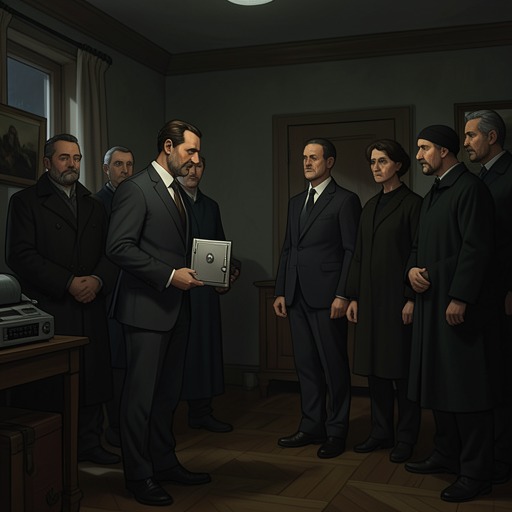
Paper-Tube Portable Door
The Portable DoorThe Paper-Tube Portable Door is a magical passage disguised as a compact, portable object: an india-rubber mat shaped like a door, carried inside a cardboard tube. It can open a route to a commanded destination, but its usefulness depends on the conditions attached to that route. In Humphrey Wells’s hands, the doorway becomes a means of imprisonment; later, its paired locks and concealed keys turn it into the puzzle Paul Carpenter and Sophie Pettingell must solve to bring the prisoners back.
Form and first use
The device’s ordinary-looking container conceals its extraordinary function. Pip and Arthur found it among objects delivered to the J.W. Wells & Co. underground strongroom, read the instructions, and tried it out. They spread the mat against a wall, opened the door that appeared, and wedged it ajar with a heavy book. Cautiously, they commanded it to take them no further than their lodgings. Stepping through, they arrived there—but the real door connecting their rooms to the rest of the building was missing. The portable doorway had transported them to a place without restoring their ordinary means of exit.
That first experiment establishes both the device’s appeal and its vulnerability. It can provide a passage beyond the wall on which it is mounted, but its users cannot assume that the destination will include an independent way out. The distinction between reaching a location and being able to leave it becomes decisive almost at once: the door works, but the room on the other side has become a trap.
Humphrey Wells’s trap
Humphrey Wells appeared in the magical doorway while Pip and Arthur were stranded in their lodgings. He said they knew too much about his business and had refused to give him a talisman; then he slammed the portable door in their faces. It vanished, leaving them in a room with no door. The same object that had carried them safely to their lodgings thus became the instrument by which Humphrey cut them off from escape. Its magic does not guarantee passage to its users; whoever controls the opening can also end their access to it.
The door’s eventual locks extend this danger into a puzzle. When Paul Carpenter and Sophie Pettingell considered how to recover Pip and Arthur, Mr Tanner’s mum pointed out that the door had two keyholes and therefore required two keys. She expected Humphrey’s handiwork to involve disguised keys or a test, recalling his enchanted office appliances: a hot-drinks machine that served coffee only to the pure in heart, and a fax machine whose toner cartridge could be changed only by a seventh son of a seventh son. Paul seized on the idea of a test, reading the obstacle through the logic of fairy tales rather than treating it as a straightforward lock.
Keys and rescue
The two keys were concealed in swords set in stone. One sword bore the inscription, “Whoso draweth this sword from this stone shall be rightful king of all England,” followed by the smaller instruction, “Please dispose of stone tidily after use.” When Paul and Sophie pulled a sword together, it came out smoothly; its tip was blunt and crinkled like the wards of a key. Paul bent the key portion sideways until the brittle metal snapped, pocketed it, and returned the sword to the stone. The grand promise of kingship and the mundane instruction about disposing of the stone make the hidden mechanism at once folkloric and comically practical.
They retrieved the second key from another sword at Paul’s flat in Kentish Town. Paul then unrolled the portable door from its cardboard tube, smoothed it out, and fixed it to a wall. The first key fitted the upper lock and its counterpart fitted the lower one. Before opening the door, he suggested that someone other than Humphrey had placed the keys there, and that he and Sophie might have been destined to find them—and each other. He gave the door a gentle shove. The passage opened, and the group went through: Mr Tanner’s mum first sent Arthur ahead to test that it was safe, then followed, with Sophie and Paul after her. Paul caught the door as it rolled up and fell off the wall; Pip and Arthur were back in his room, beside the now swordless stone.
Meaning and final appearance
The portable door links three different states of access: a thrilling shortcut, a vanished exit, and a locked route that must be recovered through cooperation and interpretation. Its mechanism does not simply reward physical force. The key-shaped sword tips require the users to notice what the objects actually are, while extracting them depends on Paul and Sophie acting together. The device’s associated objects turn a magical escape into a chain of material clues: tube, mat, wall, two locks, two keys, and finally a passage through.
At the book’s close, Sophie wonders whether Paul wishes he could return to the moment before he raised a difficult subject, and imagines that something might distract him “by magic.” A tiny light flickers behind Paul’s eyes; he reaches into his inside coat pocket and takes the top off the cardboard tube containing the door. The novel ends at that suggestive gesture, before showing whether he uses it. After serving as both prison and escape route, the portable door remains poised as a possible answer to a problem whose solution has not yet been revealed.